


Organizing a Home Office That Supports Focus and Productivity
A home office can look perfectly fine and still make it harder to work.
We see this often with busy professionals. The desk becomes a landing place for mail, papers, chargers, household items, and things that need a decision later. Supplies may technically have storage, but not necessarily near where they are used. Files accumulate because there is no clear next step for them.
Individually, none of these things seems significant. Together, they create visual distraction and one more layer of mental load during an already full workday.
When we organize a home office, we are not simply trying to create a cleaner desk. We look at how the client actually works and build the space around those routines.
Start With How You Actually Work
Before we decide where anything belongs, we look at what happens during a typical workday.
What needs to be within reach?
What do you use occasionally?
Where do papers naturally land?
What tends to accumulate on the desk?
Which items leave you getting up repeatedly or searching through drawers?
Those patterns tell us far more than a generic office-organizing checklist ever could.
A client who spends most of the day on video calls needs something different from someone who reviews physical documents, manages samples, or moves between several projects at once.
The system should reflect the work.
Edit the Desk Before Organizing It
One of the first places we usually address is the work surface.
Desks tend to collect items because they are convenient, not because everything sitting there actually supports work.
We begin by removing what does not need to live on the desk and separating the remaining items by category.
The goal is not an empty surface for the sake of appearance. It is enough visual clarity that when you sit down, the space is ready for the task in front of you.
For most clients, the desktop needs far less than they initially think: the technology they use daily, perhaps a notebook, a few writing tools, and anything genuinely required for their regular workflow.
Everything else should have a considered home nearby.
Create Zones Around Your Workday
Rather than organizing an office according to where storage happens to exist, we organize around function.
Depending on the client, that may include:
- A primary work zone for the computer and everyday tools
- A paper or action zone for items still requiring attention
- A supply zone for frequently used office materials
- A file zone for documents that genuinely need to be retained
- A technology zone for chargers, cords, and backup equipment
- Storage for categories that are necessary but not needed every day
The important part is proximity.
If something is used every day, it should not require opening three cabinets across the room.
If something is needed twice a year, it does not need prime space beside the desk.
That distinction allows the most valuable space in the office to support the work that actually happens there.
Give Paper a Clear Next Step
Paper is one of the categories we see create the most friction in home offices.
The problem is rarely the existence of paper itself. It is that different types of paper begin living together.
A bill that needs action gets mixed with a document that needs filing. Mail that has not been opened joins school paperwork, receipts, notes, and reference materials.
Without clear categories, the entire stack becomes something to deal with later.
We prefer to give paper a defined next step.
That may include:
- Incoming papers that still need review
- Action items that require a response or decision
- Documents that need to be filed
- Papers ready for shredding or recycling
We also edit what truly needs to be kept.
Many manuals, statements, and records are now available digitally. There is little value in using physical storage for paperwork that can be retrieved easily when needed.
The goal is not to eliminate paper. It is to make sure every piece has a reason for remaining in the office.
Store Supplies Where They Are Actually Used
A beautifully organized cabinet is not particularly helpful if you have to cross the room every time you need a charger or notebook.
When we organize supplies, we consider frequency of use first.
Everyday items should be easy to reach.
Backup quantities can live farther away.
Specialty items can occupy less accessible storage.
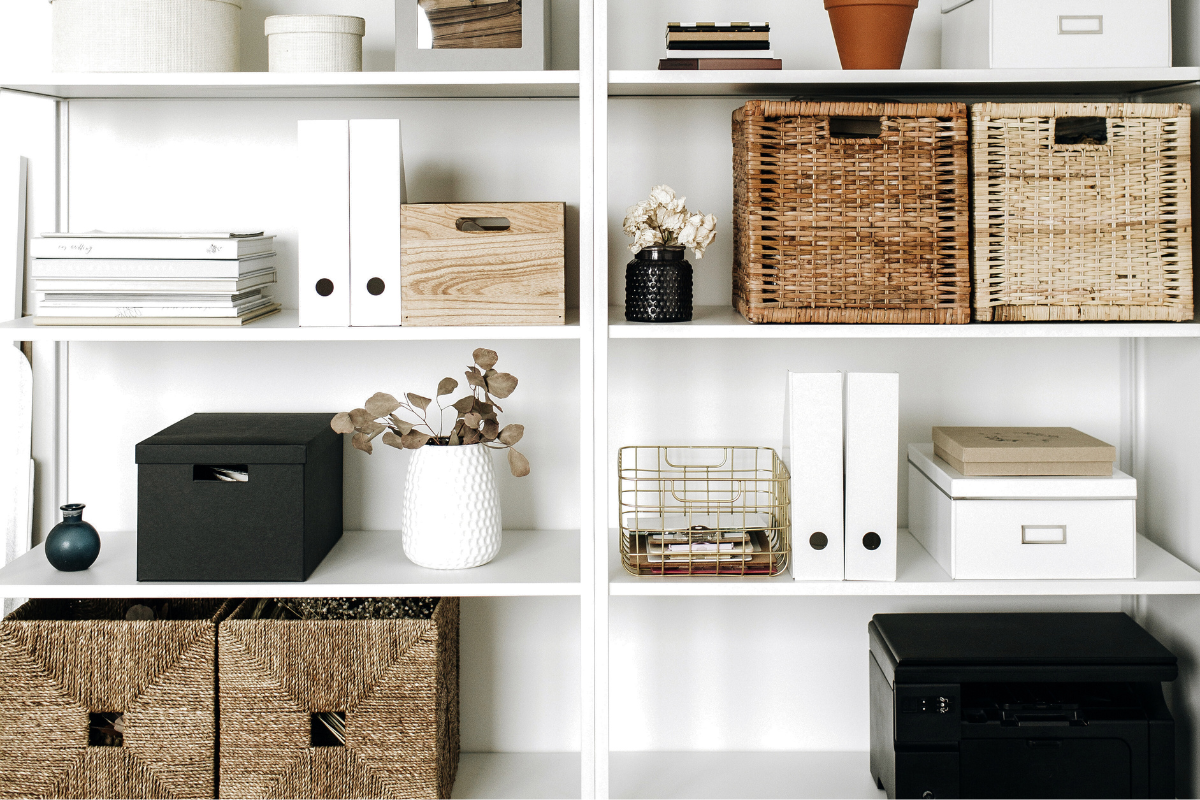
Drawer dividers, baskets, file holders, and containers can all be useful, but only after the categories and routines are clear.
Products support the system. They are not the system themselves.
This is the same approach we take throughout our Home Organizing service: editing first, understanding the routine, and then implementing storage that makes those routines easier.
Consider What Competes With Work
Home offices often become more than offices.
They may double as guest rooms, household command centers, storage spaces, or places where things land because no one knows where else to put them.
That does not automatically mean the room needs to serve only one purpose.
It does mean each purpose needs a clear boundary.
If household paperwork needs to live there, it should have a dedicated system rather than slowly taking over the desk.
If the room also functions as a guest room, work supplies need a defined home so they can be reset easily.
If family members use the office, their categories need a clear place too.
When too many functions overlap without structure, the office begins requiring constant decisions just to use it.
Keep the Things That Support Your Focus
A functional office does not need to feel sterile.
Personal photographs, artwork, books, or another meaningful object can make the room feel distinctly yours.
The difference is intention.
We would rather see a few things a client genuinely enjoys than surfaces filled simply because there was space to put something there.
The same principle applies throughout the home: what remains visible should either support the routine or add something meaningful to the experience of the space.
Make the End-of-Day Reset Easy
One of the best signs that an office system is working is that resetting it does not require much effort.
At the end of the workday, papers should have an obvious destination. Supplies should be easy to return. Cords and technology should already have homes.
A reset might take only a few minutes because the decisions have already been made by the system.
That is very different from tidying.
Tidying asks you to decide where everything should go each time.
A thoughtful system removes many of those decisions altogether.
When the Office Keeps Falling Out of Order
If you repeatedly organize your office and it returns to the same state, we would look at the system before assuming you simply need to be more disciplined.
Often, the problem is very practical.
Perhaps incoming paper has nowhere to land.
Maybe frequently used supplies are stored too far away.
The file system may contain more categories than you realistically maintain.
Or the office may be absorbing items that belong elsewhere in the home.
We see this same pattern throughout family homes. Systems begin to fail when they no longer reflect the way people are actually using the space.
We explore that more deeply in Why Family Homes Fall Into Chaos—and How to Create Systems That Flex.
A Home Office That Gives Something Back
For many of our clients, the home office is where significant decisions are made, businesses are run, careers are managed, and focused work needs to happen.
The room should support that.
You should be able to sit down and begin without first clearing yesterday’s papers, searching for something you need, or mentally processing everything sitting in front of you.
That is the value of organizing a workspace around the way you actually work.
The result is not simply a better-looking office. It is a space that reduces friction, supports focus, and makes it easier to move into and out of the workday with clarity.
If your home office or other spaces in your home are no longer supporting your routines, learn more about our Home Organizing service. We thoughtfully edit, organize, and implement systems around the way you actually live and work.
Until next time,
Elissa


