


Decluttering and Organizing Kids’ Artwork Without Losing the Memories
Children’s artwork has a way of spreading through a home almost without anyone noticing.
In the family homes we work in, we most often find it collecting on kitchen counters, tucked into drawers, or stacked in closets. A few drawings come home from school, then a project, then a painting, and before long there are several different piles waiting for a decision.
What we see most often is not that parents do not care about the artwork. It is usually the opposite. There are memories attached to so much of it, and without a clear system for what happens next, everything gets saved by default.
The solution is not to make a decision about every piece the moment it comes through the door. It is to create a simple rhythm for reviewing it, preserving what matters, and letting the rest go without the category becoming overwhelming.
Why Children’s Artwork Can Be So Hard to Edit
Artwork often carries more than what is on the page.
A painting may remind you of a particular school year. A handwritten story may capture exactly how your child sounded at that age. A drawing might not look significant to anyone else, but you remember the afternoon they made it.
That is why this category can be harder to edit than it seems.
We also find that parents often struggle more when all of the artwork is mixed together in one large pile. Drawings, paintings, schoolwork, projects, and sticker-covered crafts are all competing for attention at once.
Instead, we separate the pieces into categories first.
We might create groups for:
- Drawings
- Paintings
- Written work
- School projects
- Collages or glued artwork
- Crafts and mixed-media pieces
Once everything is categorized, decisions become much easier.
Rather than asking, “Which pieces from this entire pile should I keep?” you can look at all of the paintings together and choose the few that feel most meaningful. Then you can do the same with the drawings, the written work, and the projects.
Seeing the full category makes it much easier to identify the best of the best.
For another perspective on preserving meaningful pieces, you can also read Children’s Artwork, Preserved with Intention.
Give Incoming Artwork a Temporary Home
One of the systems we use most often with families is a smaller bin for current school-year artwork.
Rather than letting new pieces live on the kitchen counter or disappear into random drawers, everything goes into that one designated place.
The goal is not for that bin to become permanent storage.
It is a holding place.
Once every month or every other month, parents can sit down and review what has accumulated. We have found that this rhythm works particularly well because the bin stays manageable, especially in homes with multiple children.
Waiting until the end of the school year can turn a simple review into a much larger project. Going through it every month or two allows parents to make decisions while the amount still feels approachable.
For many families, this happens after the children have gone to bed, when there is time to look through the pieces without trying to make decisions in the middle of a busy afternoon.
From there, the favorites move into long-term keepsake storage.
Create a Long-Term Memory Bin for Each Child
For the pieces a family decides to preserve, we create a separate keepsake bin labeled with each child’s name.
This becomes the long-term home for the artwork, schoolwork, and other meaningful pieces that truly represent their childhood.
The distinction between the two systems matters:
The smaller school-year bin is for what has not been decided yet.
The memory bin is for what has already earned a permanent place.
That separation prevents the long-term keepsake collection from becoming another catch-all.
It also creates a natural limit. Rather than automatically adding everything that comes home, the family is intentionally selecting what feels worth preserving.
This same idea of giving categories clear roles comes up throughout our organizing work. In What Belongs in Storage—and What Should Stay Within Reach, we explore how deciding where things belong can make the entire home easier to manage.
What If Everything Feels Special?
This is where category-based editing becomes especially useful.
When a parent looks at one mixed pile of artwork, every piece can trigger a different memory, which makes it difficult to compare anything.
When we sort all of the paintings together, for example, the decision changes.
Now you can see that there are twelve paintings from the year and choose the two or three that best represent that stage.
The same works with handwriting samples, stories, drawings, and school projects.
You are not deciding whether a memory matters.
You are deciding which pieces best represent that memory.
That small shift often makes the editing process feel much clearer.
And if a parent is not ready to let something go, that is okay. There does not need to be pressure to make every decision immediately. Sometimes a piece needs another season before it becomes clear whether it belongs in the long-term collection.
That is something we can revisit during ongoing quarterly refreshes as the family and the home continue to evolve.
Let Children Be Part of the Process
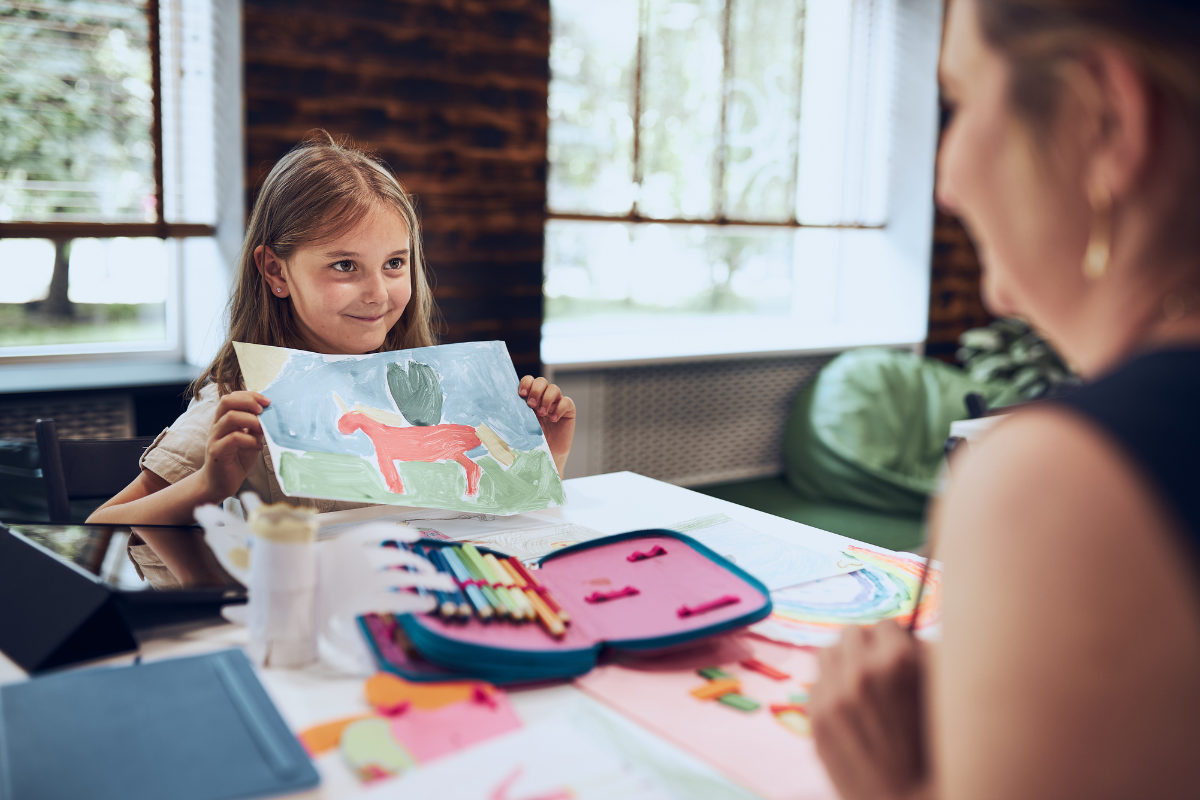
We also edit artwork with children, and their reactions can be surprisingly different from their parents’.
Some children are highly sentimental and want to preserve almost everything.
Others will happily move through an entire stack and keep one or two pieces.
Sometimes the child is ready to let something go and the parent is the one who wants to keep it.
That distinction can be helpful.
At that point, it becomes clear that the piece is really part of the parent’s keepsake collection rather than something the child personally feels attached to.
With children, we use the same category approach.
We let them see all of their paintings together or all of their drawings together and ask which ones they feel proud of or want to remember.
For sentimental children, having categories can make the process less overwhelming because they are not trying to make decisions across an entire year of work at once.
And if they are not ready, we do not force it. The system can hold those pieces until the next review.
Let Some Artwork Be Enjoyed Before It Is Stored
Not everything meaningful needs to move straight into a bin.
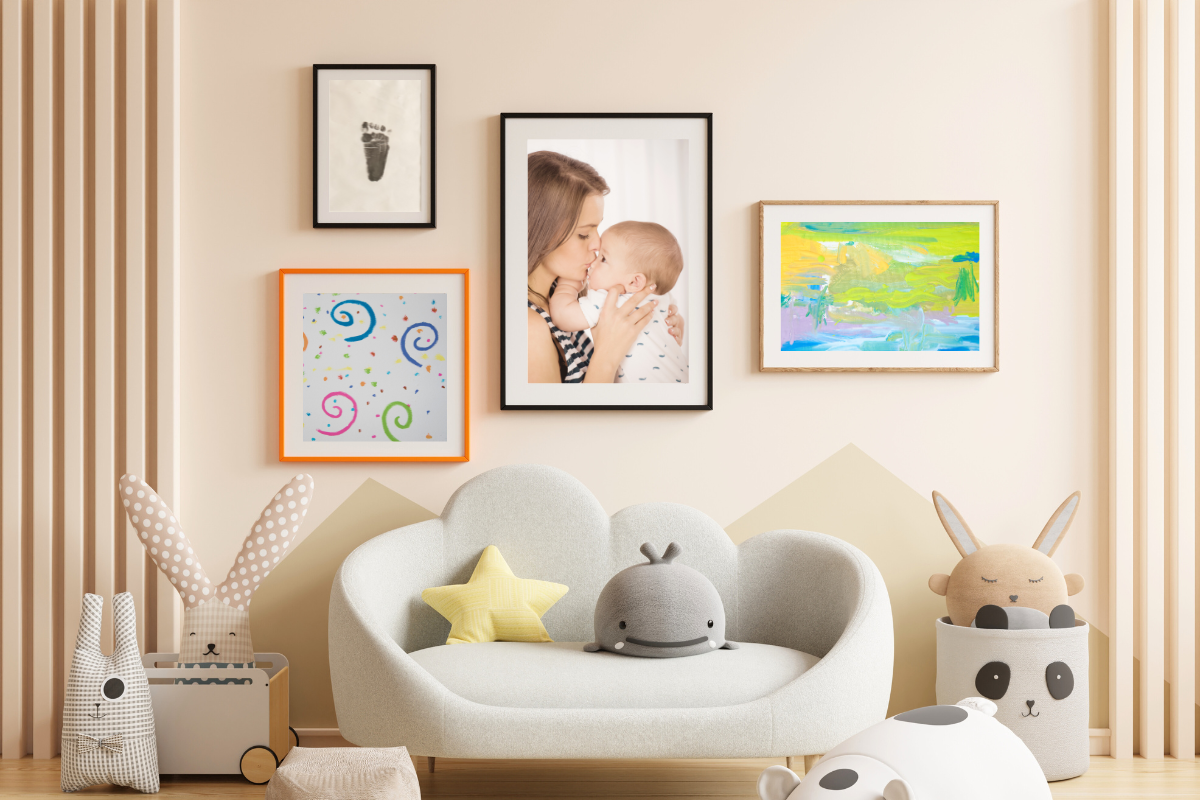
Families may want to display a few current favorites so the artwork can actually be seen and enjoyed.
That could be:
- A few changing frames
- A magnetic board
- Clipboards
- A picture ledge
- A defined gallery wall
The key is keeping the display edited.
When new pieces go up, older pieces can move into the review bin rather than collecting around the display indefinitely.
This gives the artwork a moment in everyday family life without turning every available wall or surface into permanent storage.
Preserve the Memory Without Keeping Every Original
There are also pieces you may want to remember without keeping the physical paper forever.
This is where photographing or digitizing artwork can be especially valuable.
We have recommended Artkive to clients and have used the service because it offers such a lovely way to preserve a child’s work in book form.
Instead of keeping boxes of paper that may rarely be opened, families can create a book that captures a particular year or several years of artwork in one place.
It becomes something the family can actually pull from a shelf and enjoy.
For many parents, that creates the best balance: the memory is preserved, the child’s creativity is honored, and the home does not need to hold every physical piece indefinitely.
Build a Review Rhythm That Actually Works
A system only helps if it fits into real family life.
That is why we do not recommend a rigid schedule that every household has to follow.
For some clients, once a month works well.
For others, every other month is more realistic.
A quarterly review may be enough for a child who brings home less artwork.
The important thing is that there is a rhythm before the temporary bin becomes so full that the category feels overwhelming again.
In homes with multiple children, this becomes even more important. A small amount from each child can quickly become a significant volume of paper.
Keeping the review predictable turns it into a manageable household routine rather than another large organizing project waiting to happen.
A System That Can Grow With Your Family
What comes home in preschool looks very different from what comes home several years later.
Over time, artwork may begin sharing space with essays, awards, photographs, cards, school projects, and other keepsakes.
The system should be able to evolve with that.
The bins may change. The categories may change. The frequency of the review may change.
What stays consistent is the underlying process:
Give incoming pieces one place to land.
Review them before the category becomes overwhelming.
Compare like with like.
Choose the pieces that best represent the memories you want to preserve.
Then give those pieces a thoughtful long-term home.
This is the same way we approach family organization more broadly: systems should support the household as it exists today while being flexible enough to change as children and routines do.
You can read more about that in Why Family Homes Fall Into Chaos—and How to Create Systems That Flex.
Preserve What Matters Without Keeping Everything
Children’s artwork is one of those categories that can carry a surprising amount of emotional weight.
The answer is not to become less sentimental.
It is to give those memories enough structure that the most meaningful pieces do not get lost inside everything else.
A smaller bin gives current artwork a place to land. Regular reviews keep the category manageable. Sorting by type makes decisions clearer. And a dedicated memory bin for each child gives the best pieces a permanent home.
The result is not a perfectly minimal collection.
It is a thoughtful one.
If artwork, school papers, keepsakes, or other family categories have become difficult to manage, our Home Organizing service begins with this same thoughtful editing process. We take the lead in creating systems around the way your family actually lives, then continue refining them as your routines evolve.
Until next time,
Elissa


